A club order is a different animal from a single garment purchase. It has to satisfy a committee, fit a range of members, arrive before a date that does not move, and be repeatable next season without a colour that nobody can match. On top of that, the garment has to survive a working environment — a riding club's vest is worn in arenas, in rain, over a shirt, under a jacket, and against tack and stable walls.
This page is about our embroidered softshell vests for horse riding and equestrian clubs: how a bonded softshell performs for club use, how to structure an order that a committee can approve, how crest and sponsor artwork should be prepared, and what to record so the next season's run matches this one.
Quick answer: A softshell riding vest designed for club use is a bonded, wind-resistant, water-repellent layer with a full front zip, a stand-up collar and stretch at the sides. The decoration is normally embroidery, because a club crest, a member name and a sponsor mark all need to look precise and to survive abrasion and washing. The two decisions that shape the order are how many colourways the club needs and whether individual names or initials are included — both affect how the minimum order quantity is applied.
If the brief also includes printed back graphics, compare this vest with our zipper sports vest with embroidery and printing. For a general-purpose crew vest in the same fabric family, see the zipper softshell vest with quality embroidery.
| Feature | What it provides | Why club members value it |
|---|---|---|
| Wind resistance | A bonded membrane or film inside the fabric | The single feature that decides whether a vest is worn on an exposed yard or left behind. |
| Water repellency | A finish that sheds a light shower | Enough for arena use and short spells outdoors. Ask for the specific claim if prolonged rain is a factor. |
| Weight without bulk | A light brushed inner face | Warm enough under a jacket, cool enough over a shirt, so members wear it across three seasons. |
| Sleeveless cut | Full freedom through the shoulder | Essential for rein contact and for mounting. A sleeved layer that binds at the shoulder is the most common member complaint. |
| Durable decoration | Embroidery on a bonded face | Stitch survives abrasion from tack, jackets and repeated washing, which print does less reliably on a moving garment. |
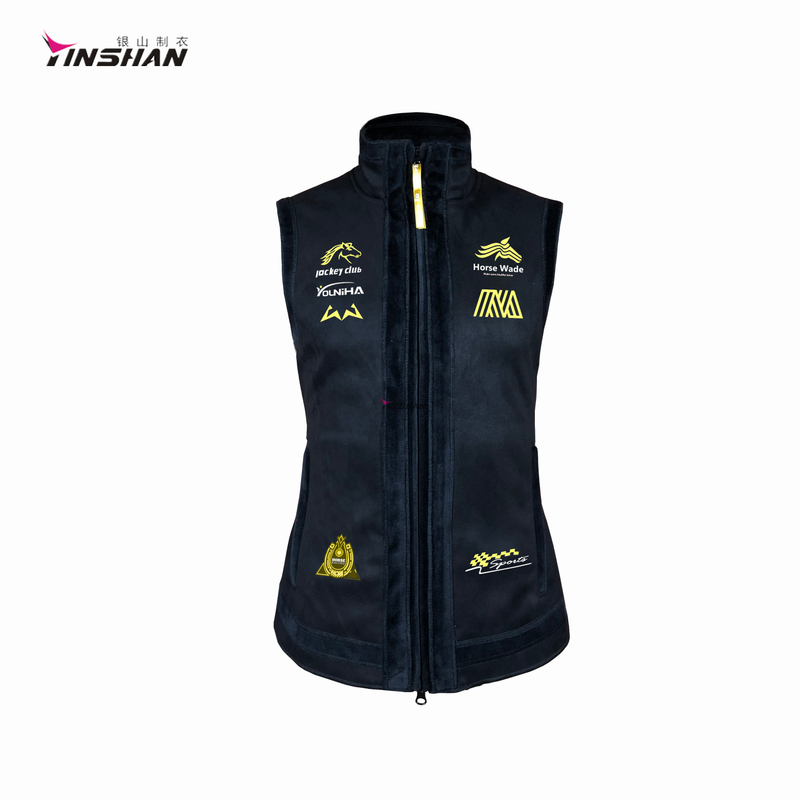
A club vest has to survive a whole season of arena use and still look presentable in the end-of-season photograph.
Club artwork tends to arrive in poor shape — a photograph of an old blazer badge, a low-resolution logo from a website, a hand-drawn sketch that has been photocopied twice. Preparing it properly is the difference between a crest that looks official and one that looks approximate.
Trace the crest into vector artwork. A clean vector file can be embroidered at any size; a photograph cannot. Once it is vectorised, the file can be reused every season.
Define the stitch colours. State the exact thread colours against a reference, rather than "club blue". Colour drift between seasons is the most visible failure on a club garment.
Set the sizes in millimetres. Crest width, name height, sponsor panel width. Numbers in a file remove an entire round of correspondence.
Plan the sponsor space. Reserve chest, sleeve or back panels for sponsors at agreed sizes, so a sponsor signed after the order can be added without redesigning the garment.
Keep the artwork on file with the supplier. A stored, digitised crest removes both the setup cost and the risk of a redrawn version next year.
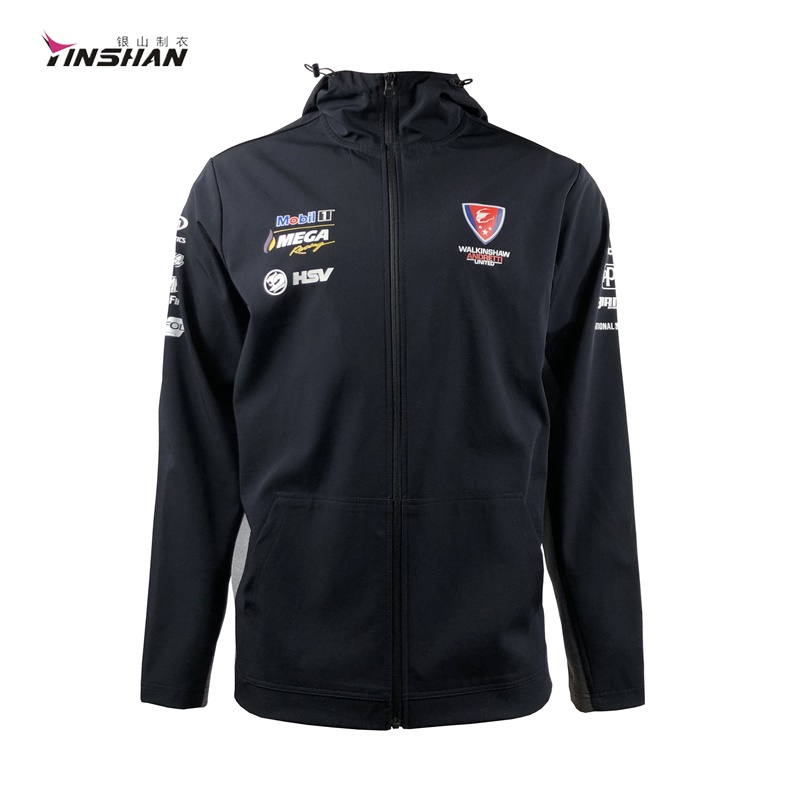
Wind resistance is the feature members notice first, and it is the reason a softshell vest gets worn on days a fleece would not.
| Decision | Options | Effect on the order |
|---|---|---|
| Colourways | One club colour, or a club colour plus a second training colour | Each colourway can carry its own minimum. Confirm this before the committee commits to two colours. |
| Decoration scope | Crest only, or crest plus names and initials | Personalisation is what turns a stock run into a made-to-order run, and it usually carries its own quantity threshold. |
| Size run | A measured size curve, or a spread of sizes chosen by members | A collected list removes most sizing arguments, but needs a deadline well before production. |
| Budget tier | Fabric weight and inner face options at different price points | Offering two tiers within one design is often how a club keeps both casual and competitive members in the same garment. |
| Repeat plan | Top-up ordering for new members | Agree up front how a later, smaller order will be handled, so new joiners are not left without a vest. |
Club orders are usually repeated each season, so a stored crest file and a recorded fabric reference are worth more than any single feature.
Face fabric and inner face. Ask for the fabric reference and whether the inner is brushed tricot or mesh — it changes both warmth and price.
Wind and water claims. Get the claim in writing, distinguishing water-repellent from waterproof.
Zip and chin guard. A chin guard and a zip garage protect the neck and prevent the zip rubbing on a long day.
Pockets. Zipped side pockets for a phone or a competition number. Open pockets do not work in the saddle.
Hem. Adjustable or elasticated, so the garment stays put when the rider is standing.
Care label. Composition, decoration method, wash temperature and ironing instructions. For an embroidered club garment, the care label is what protects the crest.
Can the club choose two colours? Yes, but confirm how the minimum applies to each colourway before committing. Two colours often means two minimums, even within one design.
Can we add member names later? Individual embroidery can usually be applied to a later order, but it is more economical to collect names and sizes before the main run. Confirm the approach with the supplier when the order is placed.
Does embroidery hold up to stable use? Better than a surface print. Stitch on a bonded softshell resists abrasion from tack, jackets and washing, which is why it is the standard decoration for club outerwear.
How many seasons can the same colourway be repeated? As long as the fabric reference is recorded and the supplier holds it. Always keep the approved sample alongside the reference code.
Can the vest and a matching jacket be ordered together? Yes, and it is common. Because the two may be built on different bonded fabrics, approve the swatches side by side so the club colour matches across both garments.
Bring the club crest as vector artwork if you have it, a member list with sizes, the colourway, and the date the club needs the garments. You can send a custom requirement, compare this vest with our zipper sports vest for horse riding, or browse the wider teamwear range. Request a quote.
 English
 Español
 Português
 Français
 Pусский
 Deutsch
 العربية