Cyclists are unusually specific about their kit, and the specificity is earned. A rider spends hours in the same position, on the same three contact points, in a garment that cannot be adjusted without stopping. Buying decisions that would be trivial in another sport become significant here.
This page covers how riders choose cycling clothing — what they prioritise and in what order — and how a club turns those preferences into a bulk custom order without losing the detail that makes the kit work.
Quick answer: Riders rank four things: the pad, the fit, the fabric, and the features. The pad is chosen by ride length — a short-distance pad in a long-distance garment is the most common expensive mistake. Fit is chosen by riding position rather than standing size. Fabric is chosen by climate and season. Features — zip, pockets, reflective detail — come last and are usually settled by the club's design rather than by the individual. When a club orders in bulk, all four have to be written into the specification, because none of them can be judged from a delivery box.
The pad, or chamois, is the part of cycling kit that determines whether a long ride is comfortable, and it is the part most often under-specified in a custom order because it is invisible on the finished garment.
Ride length — pad density and shape should match typical ride duration, not the budget.
Position — pad shape varies by riding position, and a racing pad in a touring fit is a mismatch.
Attachment — how the pad is stitched in determines whether it moves against the body.
Fit tension — a pad in a loose garment chafes, whatever its specification.
For a club, the practical approach is to ask members what they ride and how long, then choose one pad specification for the club and accept that it will not suit every rider equally. Two pad options is worse than one well-chosen pad plus a base layer recommendation.
Riders size kit in the riding position, which means a garment that appears correct standing up is generally one size too loose on the bike. This is the sizing instruction that causes the most returns in a new club order.
Measure or try the garment leaning forward rather than standing upright.
Check the sleeve and shoulder in the reaching position.
Check that the rear hem stays down when bent forward.
Expect outer layers to be sized for a jersey underneath, not for a bare torso.
Because fit tolerance is tight, sampling in two sizes is worth the cost in cycling in a way that it is not in a looser field-sport garment: the grading is exposed immediately.
Cycling kit is ridden across a temperature range that can change within a single ride, so fabric choices are made for conditions and layered rather than bought as one garment for the year.
| Condition | Jersey weight | Layering approach |
|---|---|---|
| Hot and dry | Lightest wicking knit, full zip, mesh panels | Jersey over a light base layer only |
| Mild and variable | Mid-weight knit, full zip, rear pockets | Base layer plus a removable light layer in a pocket |
| Cold and dry | Heavier knit or thermal jersey | Base layer, thermal jersey, wind-blocking gilet |
| Wet | Quick-drying knit under a packable shell | Shell over the jersey rather than a waterproof jersey |
The principle is that the jersey handles moisture and the layers handle weather. Choosing the fabric criteria in more detail follows the same logic as any endurance garment, set out in selecting sportswear fabrics.
Pad specification follows ride length, and it is the single decision riders feel most on a long day.
Features are what riders discuss and the last thing that should be decided. Once the pad, fit and fabric are right, the remaining choices are practical rather than performance-related.
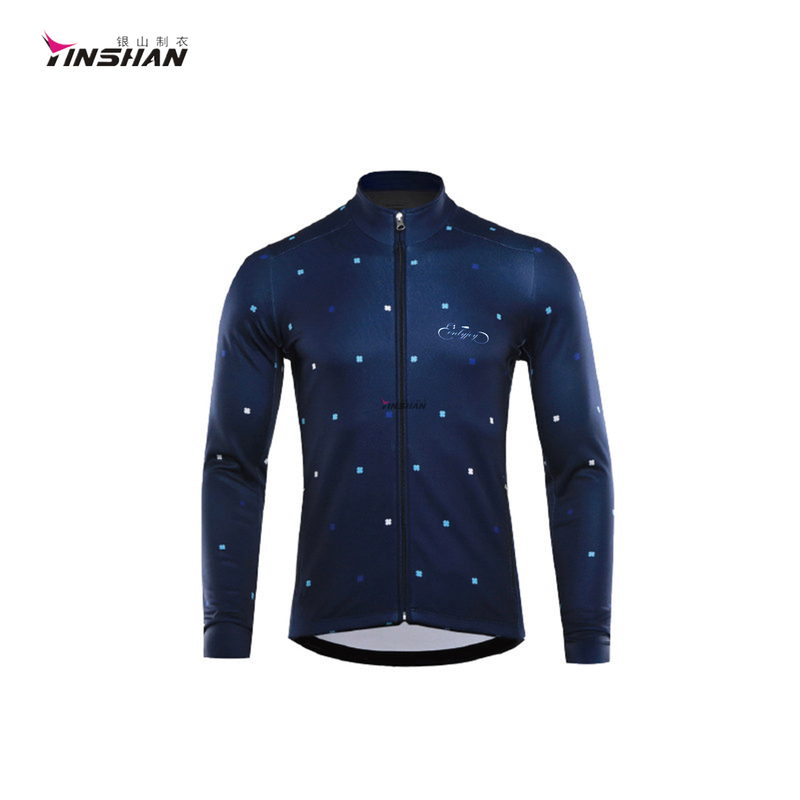
Full-length zip for temperature control, which most riders prefer to a short zip.
Three rear pockets, with a zip pocket for valuables if the design allows.
Reflective detail at the back, for visibility from behind at low light.
Gripper at the hem, so the garment stays in place through the pedal stroke.
Contrast at the extremities, which aids visibility more than a large central graphic.
Decoration decisions interact with all of this. A sponsor panel that sits across the rear pockets competes with reflective detail, and a large graphic on the contact area is both wasted and uncomfortable. The design considerations are the same as any custom kit, covered in designing sportswear that stands out.
Fabric weight should follow the climate the kit is ridden in, not the season it was ordered in.
A club cannot satisfy every rider individually in a bulk order, and trying to produces a specification with two of everything. The workable approach is to choose one specification for the majority and let riders adjust individually.
Survey members on typical ride length and climate, then choose one pad and one fabric weight.
Offer the set as jersey plus bib or short, with a light layer as an optional third piece.
Collect sizes through an order form, noting that sizes are taken in the riding position.
Keep two or three spare pieces in the middle sizes for replacements and new members.
Publish the specification, so the club can reorder identically next season.
The last point is what turns a one-off kit order into a club wardrobe. With the fabric, pad and fit recorded, next season's order is a reference rather than a new project. The reasoning behind this applies to any club programme and is set out in building a repeatable apparel programme.

A base layer that moves moisture makes more difference over four hours than any upgrade to the jersey.
Two errors recur. The first is choosing the pad by price when the pad is the part riders feel most. The second is ordering a single unisex fit for a mixed club, when sizing in cycling is close enough that the cut difference shows immediately. Fixing the second is usually a matter of ordering two blocks rather than a larger quantity of one.
By ride length and position rather than by price. A denser, longer-ride pad belongs in a garment intended for long distances, and pad shape varies by riding position. The attachment method and the fit tension of the garment around it matter nearly as much.
Yes. Kit is sized in the riding position, so a garment that is comfortable standing still is usually one size too loose on the bike. Measure leaning forward, and check the sleeve, shoulder and rear hem in that position.
One pad matched to typical ride length, one fabric weight matched to climate, the fit block or blocks needed, and the features — zip, pockets, reflective detail and hem gripper. Record all of it so next season's order matches.
For most riders, yes. A base layer that moves moisture makes more difference over several hours than an upgrade in jersey fabric, and it separates the laundry load between the two garments.
Send your members' typical ride length and climate, and we will propose a club specification — pad, fabric weight and fit blocks — that can be reordered identically next season.
 English
 Español
 Português
 Français
 Pусский
 Deutsch
 العربية