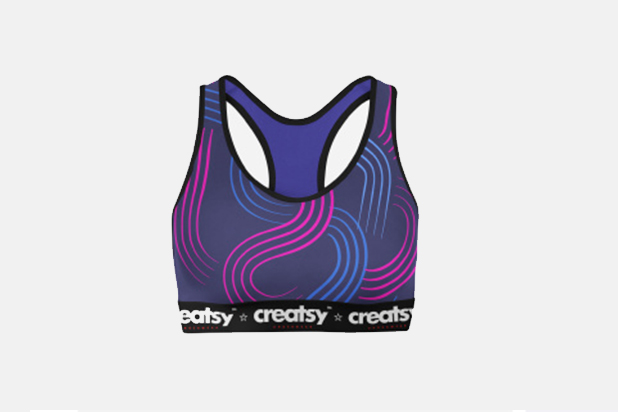
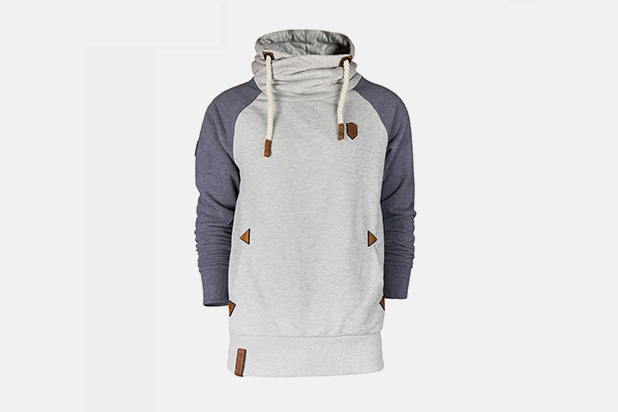
A full-zip hoodie is the most worn garment in most merchandise ranges. It is the layer that gets worn to training, to work, in the car and on the way home, and it is usually the item customers ask for again in a second colourway. That popularity is also why the decoration decision matters: a print that cracks along the zipper or lifts at the pocket is a fault the customer sees every day.
This page covers our custom zipper hoodies with heat transfer printing: what heat transfer does well, how it compares with sublimation, screen printing and embroidery, how a full-zip front changes artwork preparation, and how to order a run that holds up to washing.
Quick answer: Heat transfer printing applies a design to a hoodie as a pre-formed graphic that is pressed onto the fabric, rather than printed directly into it like sublimation or laid down as ink like screen printing. It reproduces full-colour graphics, gradients and fine detail well and gives a soft, flush finish. On a full-zip hoodie the front is split by the zipper tape, so chest artwork must be supplied as two panels with an agreed gap. Wash instructions matter more with heat transfer than with any other method, because edge adhesion is what fails first.
If your range also includes a pullover, the same design usually carries across to our cotton polyester sports hoodie or the men's jersey sports hoodie.
| Method | Best on | Where it fails |
|---|---|---|
| Heat transfer | Full-colour graphics, gradients, fine detail, small runs, personalised names and numbers | Edge lift if the care instructions are ignored, or if the graphic is pressed onto a fabric it was not chosen for. |
| Sublimation | High-polyester fabrics, all-over prints, garment-length graphics | Needs a high polyester content. On cotton fleece the colour is weak and washes out. |
| Screen printing | Bold single or few-colour designs in larger quantities on cotton fleece | Each colour needs its own screen, so colour count drives cost. Heavy deposits can stiffen a panel. |
| Embroidery | Chest logos, crests, initials, team marks | Not suited to fine gradients, and a large stitched block on fleece feels heavy and stiffens. |
For a zipper hoodie the practical combination most ranges use is a heat-transferred or screen-printed body graphic with an embroidered chest logo. That pairing keeps the large element soft and the small element premium.

A full-zip hoodie takes decoration differently from a pullover, because the front is two panels and the zip hardware crosses the print area.
Full-colour and photographic graphics. Because the design is produced as a graphic and then applied, colour count is not the cost driver it is with screen printing.
Fine detail and thin lettering. Reproduces detail that a knit print would soften, which is why it suits streetwear-style artwork.
A flush, soft finish. Well-applied heat transfer sits flat on the fabric and does not add the raised feel of a heavy ink deposit.
Small runs and personalisation. Practical for individual names and numbers, because each graphic can be produced separately.
Blanks and shorts. A practical route for brands that decorate in-house after receiving undecorated garments.
The trade-off is durability at the edges. A heat-transferred graphic will outlast the garment if it is washed and dried as instructed, and will lift early if it is tumble dried on high heat or ironed directly.
Two front panels, not one. Artwork crossing the chest must be supplied as a left and a right panel with a stated gap for the zipper tape.
Clear the zipper and the pocket. Keep the print clear of the zip line at the top and the pocket opening at the bottom, and give the measured drop from the collar.
Check the design open and closed. A hoodie is worn unzipped for most of its life. If the design only reads when closed, it will look broken most of the time.
Use the back panel for the main graphic. The back is uninterrupted and is where a large design works best on this garment.
Consider the sleeve and pocket. Small sleeve marks and a printed pocket area are cheap additions that make a design feel complete.
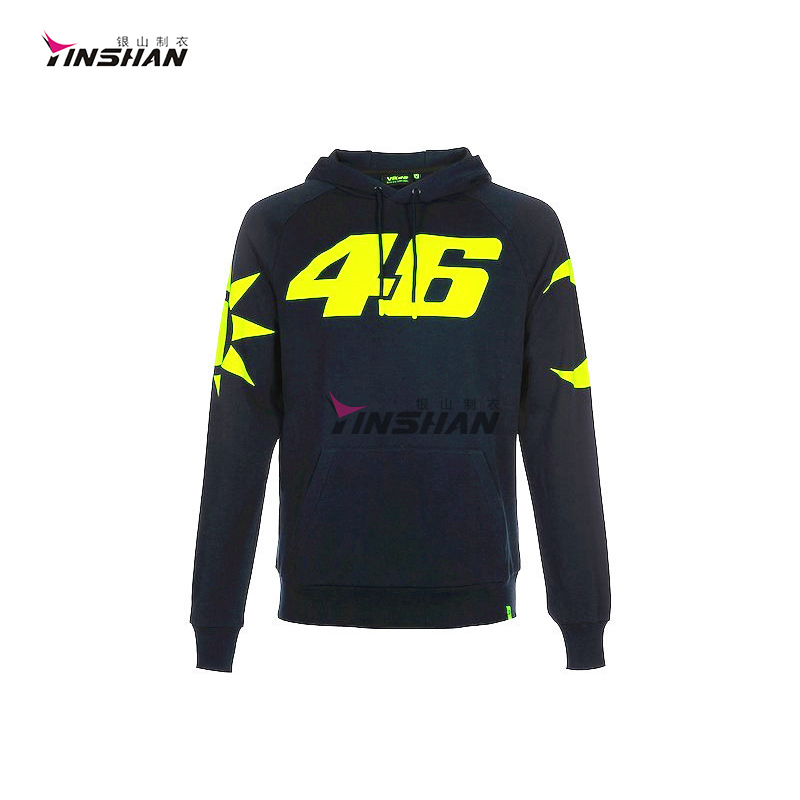
Heat transfer suits full-colour graphics and fine detail, and it gives a soft-touch finish that sits flush with the fabric.
| Element | Typical specification | Why it matters for printing |
|---|---|---|
| Body fabric | Cotton-polyester fleece or a cotton-rich brushed fleece, stated in grams per square metre | Decides whether a print method is appropriate. Heat transfer and screen print suit cotton-rich fleece; sublimation needs a high polyester content. |
| Inner face | Brushed or loopback | Brushed feels softer immediately; loopback lasts longer without pilling. It also affects how the garment sits against an applied graphic. |
| Zipper | Full-length zip, with a chin guard and a zipper garage | Protects the neck from the zip tooth and keeps the zip consistent across sizes. |
| Hood and trim | Double-layer or lined hood, flat drawcord, ribbed cuffs and hem | These are the parts that fail first on a hoodie and the parts that are most visible. |
| Labels | Care label with composition, decoration method and wash guidance | With heat transfer, the care label is part of the product warranty, not a formality. |
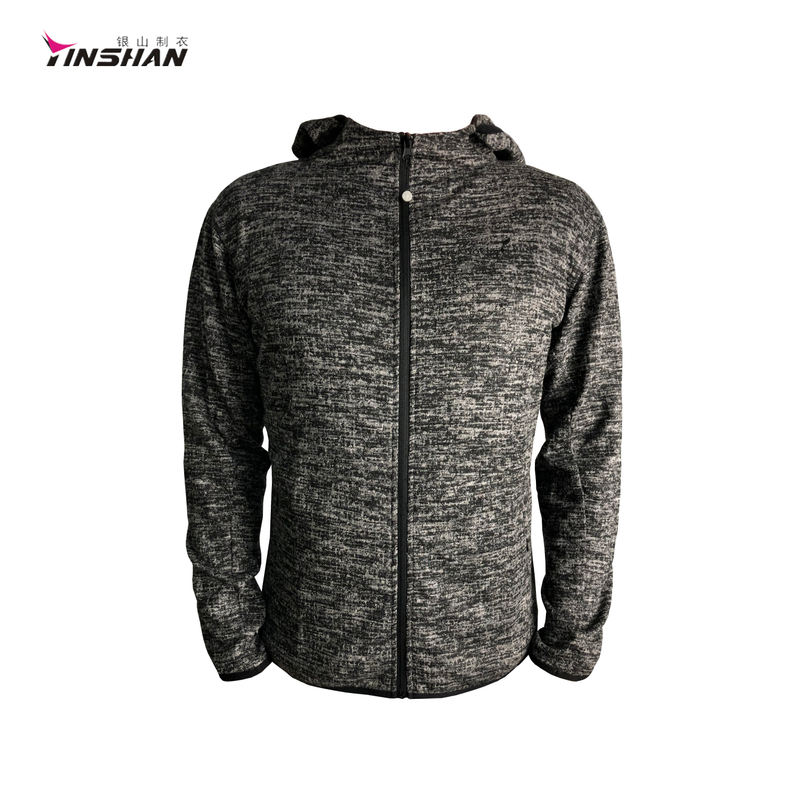
Brands and teams usually order the same design across a hoodie and a sweatshirt, so the print method has to work on both fabrics.
Streetwear and apparel brands building a full-zip piece around an existing artwork, often in several colourways.
Teams and clubs wanting a warm-up or travel layer that carries the club design and is worn off the field as well.
Schools and universities ordering campus merchandise where the print has to survive daily wear by students.
Corporate and event programmes using a printed hoodie as staff or participant apparel against a fixed date.
Minimum order quantity. Ask how it applies — per design, per colour and per decoration method — because heat transfer is often the more flexible method at low quantities.
Sizes. Take the size chart by measurement. A full-zip hoodie is cut to layer, so confirm whether a wearer should order their usual size or one up.
Colourway. Approve a fabric swatch, and check the graphic against that swatch. A dark colourway changes how a full-colour graphic reads.
Pre-production sample. Ask for a sample with the zip in place and the graphic applied, so the gap across the front and the finished feel can be judged.
Inspection points. Print registration and colour against the approved artwork, edge adhesion on a wash test, zipper function, and measurements against the stated tolerance.
Is heat transfer better than screen printing on a hoodie? It depends on the design. Heat transfer suits full-colour and detailed artwork and small runs; screen printing is usually more economical for bold designs in larger quantities on cotton fleece.
Will the print come off in the wash? Not if the care instructions are followed. Wash inside out at a moderate temperature, avoid high-heat tumble drying, and never iron directly over the graphic.
Can we print across the front zip? The design must be split into two panels with a defined gap. It cannot be applied as one continuous graphic across the opening.
Can we add embroidered logos as well? Yes, and it is the combination most ranges use: a transferred or printed body graphic with an embroidered chest logo.
Can names and numbers be added individually? Yes. Supply a controlled list with exact spelling, number and size, and ask for the list to be confirmed back before production.
Send the artwork split for the front panels plus a back design, the garment and quantity with a size breakdown, the colourways, and the date you need delivery. You can send a custom requirement directly, compare this hoodie with our cotton polyester sports hoodie, or browse the wider teamwear range. Request a quote.
 English
 Español
 Português
 Français
 Pусский
 Deutsch
 العربية