Buyers approaching a Chinese sportswear factory for the first time usually ask about price first and printing method second. The order of those questions is the wrong way round. The printing method determines what the artwork can be, what the fabric has to be, and how many pieces the run is sensible for. Price is the result of those three answers, not an independent number.
This page explains how custom sports t-shirt printing is actually organised in a factory: the four main methods, which one suits which artwork and quantity, how fabric choice interacts with print, how to specify an order so the first run matches the second, and how to check a supplier before committing.
Quick answer: Custom sports t-shirts are printed by one of four main methods — screen printing, sublimation, heat transfer and digital direct-to-garment. Screen printing suits larger runs of one design in flat colours. Sublimation suits polyester garments decorated all over, because the ink becomes part of the fabric. Heat transfer and digital printing suit smaller runs and detailed multi-colour artwork. The method is chosen from the artwork, the fabric and the quantity together, and it should be settled before the garment is chosen, because a method that is wrong for the fabric will fail regardless of how good the artwork is.
For the construction side of the garment itself, see our guide to custom sports tee shirt craftsmanship. For a printed tee in a cotton-rich knit, compare the men's cotton spandex sports tee.
| Method | How it works | Suits | Limits | Economical at |
|---|---|---|---|---|
| Screen print | Ink pushed through a mesh stencil, one screen per colour | Flat colours, bold shapes, one design repeated | Each colour adds a setup; gradients are impractical | Larger runs |
| Sublimation | Ink turns to gas and bonds into the fibre | All-over and photographic designs on polyester | Needs a polyester-rich fabric; not suitable for cotton | Any volume, once the fabric suits |
| Heat transfer | A printed carrier is pressed onto the garment | Detailed multi-colour artwork, small and mid runs | Hand feel can differ from the fabric | Small to mid runs |
| Digital direct | Ink printed directly onto the garment | Small runs, sampling, personalised pieces | Slower per piece; cost does not fall with volume | Very small runs and one-offs |
In practice, most sports t-shirt orders are split. A club might screen print the main logo because it is one or two flat colours and the quantity is large, then use heat transfer for the individual names and numbers, because those change with every piece. Splitting the order this way is normal and usually cheaper than forcing one method across the whole job.

Which printing method suits an order depends less on the technology and more on the artwork, the fabric and the quantity.
The single most common cause of a disappointing print run is a method chosen for artwork on a fabric that does not accept it.
Cotton and cotton-rich knits. Take screen print and heat transfer well. Sublimation is not an option, because the ink needs polyester to bond into.
Polyester knits. Take sublimation, which is why all-over sports kit is almost always polyester. Screen print also works but with different ink systems.
Stretch knits. Need an ink system that moves with the fabric, otherwise the print cracks along the lines where the garment flexes.
Mesh and open structures. Interrupt very fine linework, because the surface is not continuous. Bold shapes work; hairlines do not.
Two tests settle the question without argument. Ask for a print trial on the actual fabric, not on a similar one. And ask what happens to the print after ten washes, because a method that looks right on delivery and fails after a month is worse than one that looks slightly flatter and lasts.
Record the method, not just the result. "Screen print, two colours, 180 mm wide, 90 mm below the collar" repeats. "Logo on the front" does not.
Fix the ink references. Pantone references for spot colours, so a repeat order does not drift.
Fix the fabric reference. The fabric composition and weight, with a retained swatch.
Keep the approved sample. The pre-production sample is the reference for every later dispute.
Confirm the size chart by measurement and re-check it after the shrink allowance has been applied.
Agree packing. By size, by person, or polybagged individually — this is a production step and it needs to be agreed before the run, not after.

Print placement is fixed once and repeated, which is what makes a second order match the first.
Most of the risk in an overseas order is resolved by asking for things that are cheap to produce and hard to fake.
Ask for a print trial on the actual fabric. A supplier who will not produce one is telling you something.
Ask who actually prints the garments. Some suppliers subcontract the decoration, which changes both the price structure and the accountability.
Ask for the quality check points. Where is the print inspected, and what happens to a reject? A clear answer suggests a process exists.
Ask about certification where it matters. If recycled or organic content is part of the brief, ask for the relevant scope certificate and the transaction certificate for the order. Certificates are issued per site and per period, so check the validity dates and the site named on them.
Start with a sample, then a small run. The cost of both is smaller than the cost of a full run that cannot be repeated.
Sports clubs and leagues ordering matching kit and supporter shirts in one design.
Gyms and studios selling branded training tees to members.
Event organisers producing participant or crew shirts in a single design at volume.
Schools and universities running sports-day, society or leavers' shirts.
Companies using a printed tee for campaigns, launches or staff events.
Brands and distributors commissioning a printed range where consistency between drops is the priority.
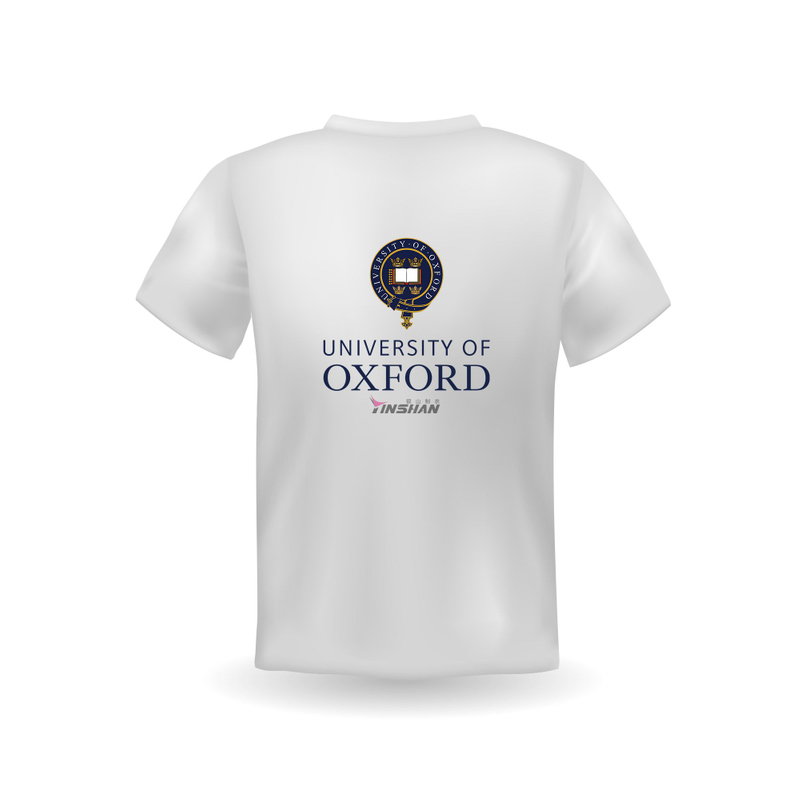
Packing by size is a production step, not an afterthought, and it is worth agreeing before the run starts.
Which printing method is cheapest? It depends on the run size and the number of colours. Screen print is cheapest per piece at volume; heat transfer and digital printing are cheaper for small runs and multi-colour artwork.
Can you print on cotton with sublimation? No. Sublimation needs a polyester-rich fabric for the ink to bond into. Cotton takes screen print or transfer instead.
Can individual names and numbers be added? Yes, and they are usually applied by a different method from the main logo, because each piece is different. Send one row per person with exact spelling.
Will the print crack? Not if the ink system matches the fabric's stretch and the curing is correct. On a stretch knit this is the main technical requirement.
How should printed t-shirts be washed? At a moderate temperature and inside out, without high-heat drying, and without ironing directly over the printed area.
Do you handle the full order including packing? Yes, and packing should be specified in advance — by size, by person or individually bagged — because it is part of production rather than a finishing detail.
Send the artwork with the number of colours and whether it contains gradients, the fabric you intend to use or the way the shirt will be worn, the quantity per size, whether individual names are needed, and the date the shirts must be delivered. You can send a custom requirement directly, compare methods against our polyester wicking printed tee, or browse the wider teamwear range. Request a quote.
 English
 Español
 Português
 Français
 Pусский
 Deutsch
 العربية