Embroidery is the oldest decoration method in sportswear and still the first choice for a logo that has to last. It is also the method whose quality is most dependent on preparation: the same artwork can produce a crisp mark or a puckered mess depending on how the file was digitised and what backing was used.
This page explains how embroidery works in sportswear manufacturing — digitising, stitch types, backing, placement and durability — and when a buyer should choose it over printing.
Quick answer: Embroidery converts artwork into a stitch file through digitising, then sews it onto the garment with a backing material underneath for support. The three decisions that determine the result are the digitised stitch count, the backing chosen for the fabric, and the placement relative to seams and stretch. Embroidery is the right choice for a logo that must survive years of washing and for marks that benefit from a raised, tactile finish. It is the wrong choice for fine text, gradient artwork, or very light fabrics without support.
Digitising — artwork is converted into a stitch file, with stitch types, directions and densities set for the fabric.
Backing — a stabiliser is placed behind the fabric so the stitches do not distort or sink into it.
Topping — a water-soluble film prevents stitches disappearing into a very textured fabric such as fleece.
Sewing — the file is run on a multi-head machine, one head per garment position.
Finishing — backing trimmed, topping removed, and the mark checked against the approved sample.
The digitising stage is where most quality is decided, and it is invisible to the buyer. A file digitised for a heavy woven fabric will not produce the same result on a light performance knit. This is why the fabric and the decoration should be specified together rather than sequentially, as described in custom design and manufacture.
| Stitch type | Effect | Best used for |
|---|---|---|
| Satin | Smooth, raised, glossy | Lettering, borders, small solid shapes |
| Fill | Flat coverage across an area | Larger marks and backgrounds |
| Run / walk | Thin outline | Fine detail, outlines, small lettering |
| 3D foam | Pronounced raised effect | Large simple marks on heavier fabrics |
Stitch count follows from these choices, and so does cost. A large filled mark consumes far more stitches than the same mark drawn as an outline, which is why embroidery quoting is done by stitch count rather than by size alone. The pricing consequence is covered in the cost of custom embroidery.
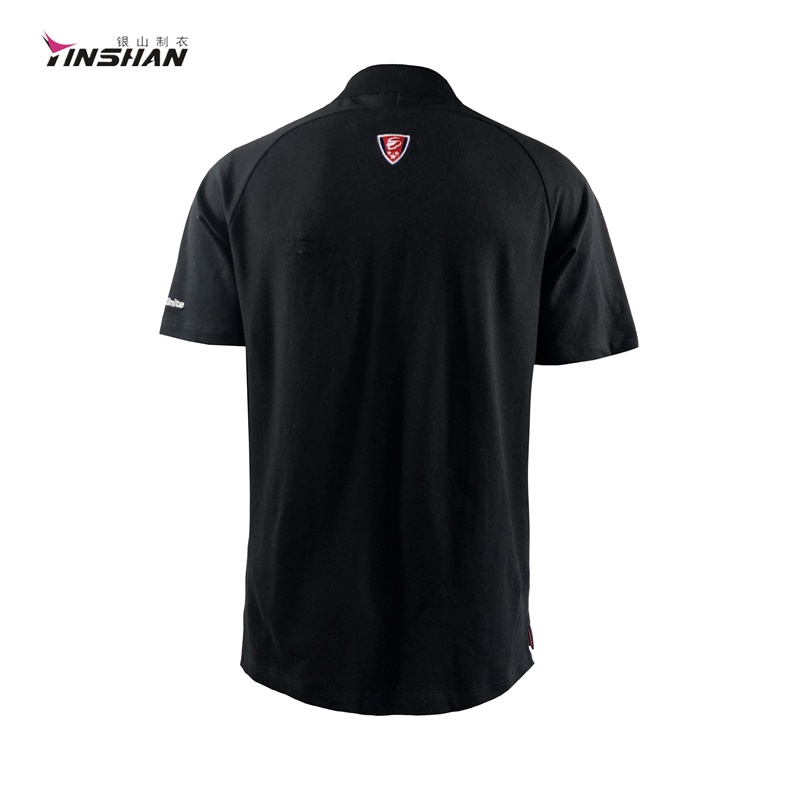
Embroidery is chosen for permanence: a stitched mark does not crack, peel or fade like a print.
Backing is the variable that separates a professional result from a puckered one, and it is the thing buyers never see. Choosing it correctly depends entirely on the fabric.
Light performance knits — cut-away backing, because the fabric cannot support dense stitching alone.
Mid-weight knits and pique — cut-away or tear-away depending on mark size and stretch.
Fleece and textured knits — backing plus a topping film, so the stitch sits on the surface.
Heavy woven fabrics — a lighter backing is usually sufficient.
Stretch panels — avoid high-density embroidery entirely, since the fabric will distort as it stretches.
The practical consequence for a buyer is that embroidery placement has to respect the garment's construction. A mark placed across a stretch panel, a seam or a pocket edge will distort the fabric or sit badly. Placement is a specification item, not a design afterthought.
A well-executed embroidered mark outlasts the garment. It does not crack, peel or wash out, and its colour stays stable because the thread is dyed rather than printed onto a surface.
Resistant to the washing that destroys prints, at the temperatures the fabric allows.
Stable in colour, since thread colour does not degrade like surface ink.
Repairable — a pulled stitch can often be re-sewn, which is not true of a failed print.
Limit — fine text and gradients are not achievable, and small type tends to fill in.
The limit is the reason some artwork has to move to print. Fine lettering below a certain size, gradients and photographic artwork cannot be reproduced in stitches, and attempting them produces a mark that reads as a smudge from any distance. The print comparison is in custom sportswear printing.

Stitch density and backing are decided together with the fabric, because a light knit needs support and a heavy one does not.
| Consideration | Embroidery | |
|---|---|---|
| Durability over years | Better | Good, but degrades faster |
| Fine text and gradients | Not achievable | Achievable |
| Colour count | Each colour is a thread change, cost rises with count | Cost rises with positions and colours, but more gradually |
| Perceived quality | Reads as formal and durable | Reads as graphic and modern |
| Large coverage area | Expensive and heavy | Efficient |
| Light or stretch fabrics | Needs support; unsuitable on stretch panels | More tolerant |
The most useful pattern is a combination: a small embroidered mark for the identity, plus print for larger graphic elements where the design calls for them. Many club ranges use precisely this structure, and the reasons are set out in embroidery in sportswear manufacturing.

A crest with clear shapes and a limited colour count is the ideal embroidery artwork; fine detail is where it starts to fail.
Supply vector artwork, or a high-resolution file, rather than a photograph of a logo.
State the mark size in centimetres, since size drives stitch count and cost.
Confirm the placement against the garment's construction and any seam or panel.
Ask for the backing approach, because it is what decides the finished quality.
Approve a sewn sample on the actual fabric, not a digital simulation.
Keep the stitch file on record so a repeat order is identical.
The last point matters for clubs and brands more than for a one-off buyer. A digitised file held on record makes every subsequent order identical and removes the setup charge, which is why the specification should include the file reference as well as the artwork.
Artwork is digitised into a stitch file, a backing material is placed behind the fabric for support, and a multi-head machine sews the design at one head per garment. The digitising and the backing choice determine the finished quality more than the machine does.
Yes. A stitched mark does not crack, peel or fade like surface ink, and it can often be repaired if a stitch pulls. The trade-off is that fine text, gradients and photographic artwork cannot be reproduced in stitches.
Most knits and wovens can be embroidered with suitable backing. Light performance knits need cut-away backing, fleece needs a topping film, and stretch panels are best avoided because the fabric distorts when it stretches.
Cost follows stitch count, and a larger filled mark consumes far more stitches than a small one or an outline version of the same shape. Quoting by size alone rather than by stitch count is a sign the digitising has not been considered.
Send the artwork and the fabric you are decorating, and we will digitise it, advise on backing and mark size, and produce a sewn sample on the actual garment before the order is placed.
 English
 Español
 Português
 Français
 Pусский
 Deutsch
 العربية