Most custom shirts carry a logo. Artwork printing is for the orders where the design itself is the point — a bespoke illustration across the chest, an illustrated back panel, a graphic built for a campaign, a season launch or a limited club release. The garment is the same cotton sports shirt; what changes is how much of it the print covers and how carefully the artwork has to be prepared.
This page covers our custom cotton sports shirts with artwork printing: what the print process does well on cotton, how artwork should be prepared for a fabric that is not flat, what the realistic limits are on detail and colour, and how the order is normally structured for teams, brands and workwear programmes.
Quick answer: Artwork printing places a full graphic — not just a logo — onto a cotton sports shirt. On cotton the print sits on a soft knit surface, so bold shapes, strong contrast and open detail reproduce better than very fine linework. Artwork should be supplied in vector format with fonts converted to outlines, and at the size and position it will be printed. For orders that mix a large artwork print with a formal logo, embroidery is usually added for the logo so the two elements do not compete.
If the design is a logo rather than a full artwork, the closer match is our personalised cotton sports shirt with front printing and embroidery. For the wider production process behind these shirts, see the guide to sports tee shirt production.
Campaign and brand graphics. A design that has to be reproduced faithfully across a size run, in colours that match a style guide.
Illustrated club or school releases. Bespoke artwork made for one season, one event or one anniversary, worn as much off the field as on it.
Merchandise ranges. Several designs sharing one garment body, where the artwork carries the difference between items.
Workwear and staff programmes. A printed back panel or full-front graphic used to identify crews, with a smaller embroidered mark on the chest.
Large graphic treatments. Designs where the printed area is deliberately big, so the shirt reads as a designed object rather than a decorated blank.

Artwork printing lets the design lead: the garment becomes a canvas rather than a shirt with a logo attached to it.
| Design element | On cotton, expect | What to do |
|---|---|---|
| Bold shapes and blocks | Reproduces cleanly and holds its edge | Use them as the foundation of the design. |
| Fine linework | Can fill in slightly or soften at the edges | Increase the weight of the thinnest lines, or move the detail into an embroidered element. |
| Photographic detail | Reads flatter than on a screen, particularly on a coloured garment | Posterise the image or separate it into fewer tones rather than printing a full-tone photograph. |
| Gradients | Reproduce better on a light base than on a dark one | Approve the proof on the actual fabric colour, not on white. |
| Small type | Legible above roughly 5–6 mm depending on the font | Keep small lettering in a heavier weight and avoid narrow typefaces. |
| Large solid coverage | Adds weight to the printed area and can stiffen the panel | Consider leaving the design open, or move part of it onto a back panel. |
Two habits prevent most artwork problems. First, prepare the file at print size rather than scaling a small graphic up, because scaling up loses the crispness that makes a design look intentional. Second, see the print on the actual cotton colourway before the run starts.

Cotton takes print differently from a performance fabric, so solid shapes hold better than fine photographic detail.
Vector files, outlines, print size. Supply vector artwork with fonts converted to outlines, sized to the printed dimensions. Include the position on the garment.
Separate printed and embroidered elements. Mark clearly which parts of the design are printed and which are stitched, and provide a separate file for each.
Colour references. State your brand colours and confirm how they will be matched. If part of the design is embroidered, ask to see the thread reference as well as the print.
Proof on the real fabric. A screen proof is not a fabric proof. Ask to see the design printed on the actual cotton in the actual colourway before the production run.
Keep the approved file on record. A stored artwork file removes both the setup cost and the risk of a redrawn version on a later reorder.
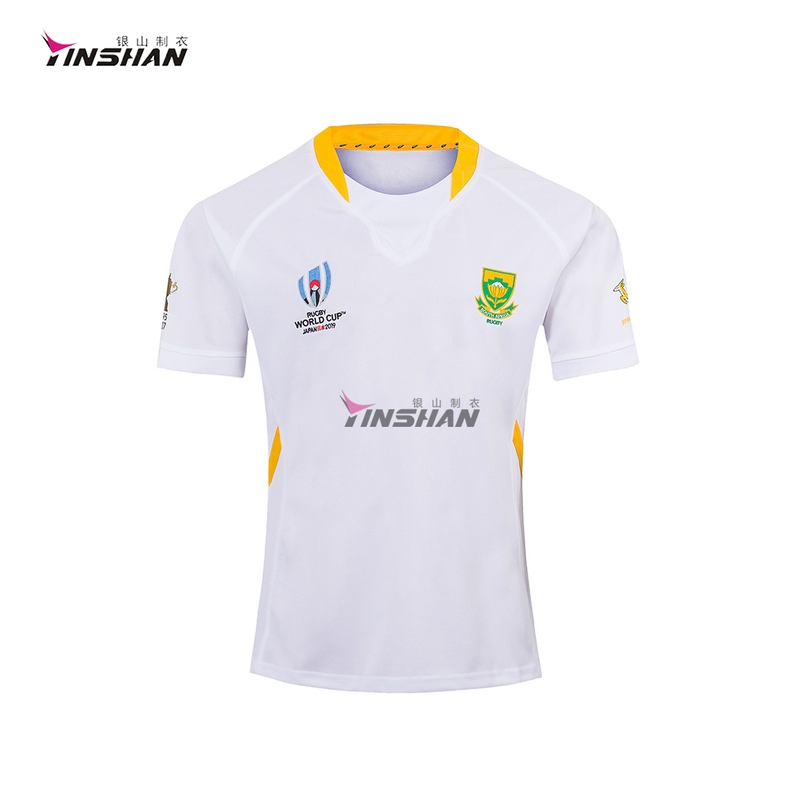
For bespoke artwork the safest route is to approve the print on the actual cotton colourway before the production run begins.
| Buyer | Typical brief | What to decide first |
|---|---|---|
| Team or club | One artwork design, a size run, often with individual names on the back | The size curve and whether names are printed or applied separately. |
| School or university | A design for a year group, a society or an event, ordered in cycles | Whether the artwork stays on file for next year's run. |
| Brand or retailer | Several artworks on one garment body, in more than one colourway | Consistency of the garment specification between designs. |
| Workwear buyer | A printed back or front panel plus a small chest mark | Whether durability or readability matters more at the print size used. |
For any of these, the minimum order quantity should be quoted per design, per colour and per decoration method, because a multi-design order can carry more than one minimum.
Wash inside out at a moderate temperature and avoid washing printed garments with abrasive items.
Do not iron directly over the printed area. Press on the reverse or use a cloth.
Avoid tumble drying on high heat, which stresses both the print and the cotton.
Include a care label with the composition, the decoration method and the wash guidance, so the shirt performs as expected across its life.
Can any artwork be printed on cotton? Most designs can, but very fine detail and full-tone photography reproduce less precisely than on a screen. Simplifying a detailed design usually produces a better garment than scaling it up.
Can we combine artwork printing with embroidery? Yes, and it is common. Print the large graphic and embroider the logo, the crest or the letters that must stay sharp.
Can the design go on the back as well? Yes. Two-sided printing is standard; state both panels with their sizes so the artwork is prepared correctly for each.
Is the print durable? Printed graphics on cotton last well when the care instructions are followed, particularly the advice against ironing directly over the print.
What quantity do we need to order? It depends on the design, the number of colours and the decoration method. Ask for the minimum to be quoted separately for each, rather than as one headline figure.
Send the artwork at print size with printed and embroidered elements separated, the garment and quantity, the colourway, and the date the order is needed. You can send a custom requirement directly, compare this shirt with our personalised cotton sports shirt, or browse the wider teamwear range. Request a quote.
 English
 Español
 Português
 Français
 Pусский
 Deutsch
 العربية